2025 Houston Real Estate Market Update

Overview The Houston real estate market in 2025 proved to be more resilient and balanced than many expected. After the volatility of prior years, the market shifted toward stability, giving buyers more options, sellers clearer pricing signals, and investors renewed confidence in long-term fundamentals. Houston continued to benefit from strong job growth, population inflows, and relative affordability compared to other major U.S. metros. Interest Rates and Buyer Behavior in 2025 Mortgage rates remained elevated compared to pre-2022 levels, but rate volatility decreased significantly as 2025 progressed. This stability mattered more than the absolute rate level. What we saw locally in Houston: Buyers paused early in the year as rates moved higher, then re-entered the market once rates stabilized and sellers began offering concessions—particularly on new construction and move-up homes. As a result: Buyer confidence improved in the second half of the year Pre-approvals and purchase activity increased Refinancing activity picked up selectively as borrowers planned future opportunities Inventory and Home Prices Inventory Trends Houston inventory remained tight but gradually improving throughout 2025. More listings came online as homeowners adjusted to the higher-rate environment and builders delivered additional supply. Entry-level and mid-price homes remained competitive Higher-priced homes saw longer days on market New construction added meaningful inventory in suburban markets Pricing Movement Home prices in Houston continued to rise modestly, supported by: Strong employment in energy, healthcare, and logistics Continued population growth across Texas Houston’s affordability relative to other large metros Price growth was measured rather than speculative, which helped sustain demand without overheating the market. Neighborhood and Segment Trends Different parts of the Houston market performed differently in 2025: Inner Loop neighborhoods remained attractive to professionals and investors seeking walkability and proximity to employment centers Suburban areas continued to draw families prioritizing space, schools, and value Outer suburbs and master-planned communities saw strong demand tied to new construction and flexible work arrangements Rental demand also remained strong, supporting investor interest in both single-family and small multi-family properties. New Construction and Builder Activity Builder confidence improved throughout 2025 as supply chains normalized and buyer demand stabilized. New construction played a critical role in easing inventory constraints. Key trends included: Increased incentives from builders More flexible financing options Strong demand from move-up buyers New construction became a practical alternative for buyers struggling with resale competition. What This Means Going Forward For Buyers More choices than prior years, but competition still exists Preparation and financing strategy matter more than timing the market New construction deserves serious consideration For Sellers Accurate pricing is essential Homes that are well-prepared still sell efficiently Buyer sensitivity to monthly payments is high For Investors Fundamentals remain strong Cash flow and location matter more than short-term appreciation Houston continues to offer long-term value Outlook for 2026 Looking ahead, the Houston real estate market is positioned for: Continued population growth Moderate home price appreciation Ongoing demand driven by employment and affordability While interest rates remain a key variable, the overall outlook suggests stability with opportunity, not volatility. Final Thoughts The 2025 Houston real estate market rewarded informed, prepared participants. Buyers who focused on fundamentals, sellers who priced realistically, and investors who prioritized cash flow all found success. As the market moves into 2026, Houston remains one of the most dynamic and resilient housing markets in the country.
Read More

Houston Home Loans and Real Estate Services

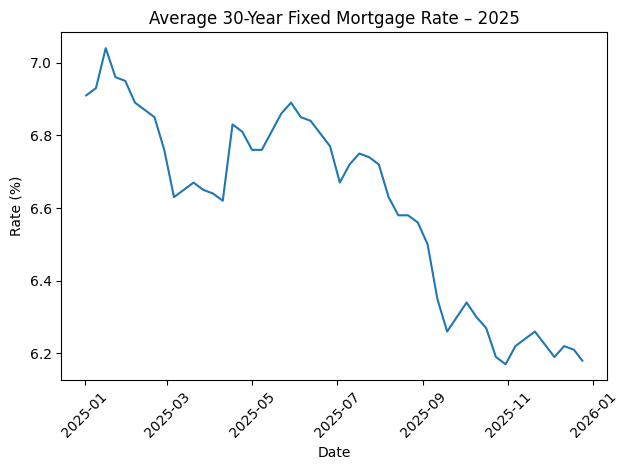
In Houston, we saw buyers hesitate early in the year as rates climbed, then re-enter the market once pricing stabilized and seller concessions increased—especially on new construction and move-up homes. As 2025 comes to a close, one thing is clear: mortgage rates mattered—but how they moved mattered even more. At the beginning of the year, the average 30-year fixed mortgage rate briefly climbed above 7%, creating hesitation among buyers and freezing activity for many homeowners who had grown accustomed to lower rates. By the end of 2025, that same rate had drifted closer to 6.2%, a meaningful shift that quietly changed affordability across the market. This blog breaks down what actually happened in 2025, what it meant for buyers and homeowners, and how to think about mortgage strategy heading into 2026. A Look at Mortgage Rate Trends in 2025 Rather than one dramatic move, 2025 was defined by gradual change. Early 2025: Rates peaked just over 7%, driven by inflation concerns and uncertainty around Federal Reserve policy. Mid-Year: Rates stabilized in the mid-6% range as inflation cooled and bond markets adjusted. Late 2025: Rates edged lower and flattened, finishing the year around 6.2%. For many consumers, this slow decline went unnoticed. But for those actively watching the market, it created windows of opportunity—especially when paired with the right loan structure. Why the Rate “Headline” Misses the Bigger Picture A common mistake in 2025 was focusing solely on the headline rate. Two borrowers quoted the same interest rate often ended up with very different monthly payments due to: Loan structure (fixed vs. ARM, term length) Points or lender credits Credit profile and debt-to-income ratio Property type and occupancy Timing within the rate trend The reality is that strategy often mattered more than the absolute rate. Buyers who stayed flexible and worked through multiple scenarios frequently outperformed those waiting for a single “perfect” number. What 2025 Meant for Homebuyers Despite higher rates compared to prior years, 2025 was not a bad year to buy—it was a selective year to buy. Successful buyers in 2025: Focused on monthly payment, not just price Used rate buydowns and seller concessions Took advantage of reduced competition Planned refinances strategically rather than emotionally For many, buying in 2025 meant securing the home first and optimizing the loan later—a mindset shift that proved effective as rates eased. What 2025 Meant for Homeowners For homeowners, 2025 reinforced an important truth: refinancing is not only about lowering the rate. Many homeowners benefited from: Term reductions (30 → 20 or 15 years) Cash-out refinances for renovations or debt consolidation Removing mortgage insurance Improving loan structure for future flexibility Even without a dramatic rate drop, strategic refinances made sense for the right situation. Looking Ahead to 2026 No one can predict mortgage rates with certainty. What 2025 showed us is that preparation beats prediction. Heading into 2026, the most successful buyers and homeowners will: Understand their numbers in advance Monitor trends instead of headlines Use professional guidance to evaluate options Act decisively when opportunities appear Mortgage decisions are rarely one-size-fits-all. The right answer depends on timing, goals, and structure—not just the rate on a screen. Final Thoughts 2025 reminded us that mortgage markets reward strategy, not guesswork. If you are considering buying, refinancing, or simply want a second opinion on your options as we head into 2026, having a clear plan matters more than waiting for perfect conditions. If you have questions or want to review scenarios specific to your situation, I’m always happy to help. Ben HelsteinInSync Homes & Loans
Read More

Brays Oaks Houston Neighborhood Guide and Homes for Sale

Brays Oaks is one of Houston’s most affordable areas located near the Texas Medical Center, offering a range of established neighborhoods with strong value potential. Situated just outside the inner loop, Brays Oaks provides convenient access to major employment hubs, Beltway 8, Highway 59, and everyday shopping and dining. Neighborhoods within Brays Oaks—such as Fondren Southwest—feature larger lots, mature trees, and home styles you rarely find in newer developments at comparable price points. In this guide, we break down home prices, neighborhood characteristics, and who Brays Oaks is best for, plus current homes for sale. Location & Accessibility Brays Oaks is strategically located near major thoroughfares including Beltway 8, Highway 90, and the Southwest Freeway (US-59). This makes commuting to the Texas Medical Center, Downtown Houston, Sugar Land, and West Houston straightforward. Braes Bayou runs along parts of the neighborhood, adding green space and walking opportunities while enhancing the overall feel of the area. Housing & Neighborhood Character Most homes in Brays Oaks were built in the mid-1970s through early 1980s, with a mix of traditional one- and two-story single-family homes. In recent years, select streets have seen high-end new construction, pushing price points well above historical norms and signaling renewed buyer interest. Typical features include: Larger floor plans compared to newer entry-level subdivisions Mature landscaping and established streets Two-car garages and functional lot sizes A mix of original homes, renovated properties, and brand-new builds Current Market Snapshot (Early 2026) Based on a recent market analysis of single-family homes in the neighborhood, the data shows a wide but healthy price range, reflecting both original homes and new construction activity. Key highlights: Active listings: Roughly mid-$200s up to over $1.1M for new construction Median sold price: Approximately $240,500 Average home size: Around 2,900–3,100 square feet Lot sizes: Commonly 7,500–9,000+ square feet Construction years: Predominantly late 1970s, with new homes built as recently as 2025 This price diversity makes Fondren Southwest attractive to both entry-level buyers seeking value and move-up buyers looking for space or custom homes without leaving the city. Why Buyers Choose Brays Oaks Value per square foot: Compared to many inner-loop neighborhoods, buyers often get significantly more home for the money. Central location: Easy access to major job centers without premium inner-loop pricing. Upside potential: Ongoing renovations and new construction support long-term appreciation. Established community: Quiet streets, longtime homeowners, and a stable neighborhood feel. Is Brays Oaks Right for You? If you are looking for a Southwest Houston neighborhood with solid fundamentals, flexible price points, and improving market momentum, Brays Oaks deserve a closer look. Whether you are buying your first home, upgrading to a larger property, or exploring long-term investment potential, this area offers options that many buyers overlook. If you would like a customized home search, pricing guidance, or a property-specific analysis in Brays Oaks, I am happy to help you evaluate opportunities and navigate the market with confidence. View current homes for sale in Brays Oaks
Read More

Houston Buyer Guide – Real Buying Power vs Pre-Approval

Most Houston buyers assume a mortgage pre-approval tells them exactly what they can afford.In reality, it usually doesn’t. Pre-approvals are based on best-case assumptions. Real buying power depends on your monthly payment after taxes, insurance, and other real-world costs. That gap is why payments often change after buyers go under contract — and why two buyers with the same pre-approval can end up in very different homes. What a mortgage pre-approval actually measures A pre-approval is a snapshot, not a full picture. Most lenders base it on: Stated income Credit score Current interest rate A rough estimate of housing costs What’s often missing is how those numbers behave once a specific home is involved. Pre-approvals are designed to answer one question: “What’s the maximum loan amount this borrower could qualify for?” They do not answer: “What monthly payment will this buyer be comfortable with long term?” That distinction matters. The Houston-specific costs buyers underestimate Houston creates unique affordability challenges that don’t show up early enough in the process. Property taxes vary dramatically Two homes with the same price can have very different tax bills depending on: Location MUD districts School districts Homestead exemptions Taxes alone can change a payment by hundreds of dollars per month. Insurance has changed fast Insurance costs in Houston are not static. Many buyers are surprised when: Quotes come in higher than expected Flood considerations affect premiums Final insurance numbers differ from early estimates HOA fees are often ignored early HOA dues are easy to overlook during pre-approval, but they count toward your monthly obligation and affect buying power directly. When these factors are layered in late, the payment changes — not because something went wrong, but because the full picture finally comes into focus. Why monthly payment matters more than purchase price Buying power isn’t about the highest price you can qualify for.It’s about the payment you can comfortably afford. Consider this common situation: Two buyers Same income Same credit Same pre-approval amount One buyer chooses a home with: Lower taxes Predictable insurance Modest HOA fees The other doesn’t. Even with the same pre-approval, those buyers end up with very different monthly payments — and very different levels of financial stress. That’s why experienced buyers shop by payment, not by headline loan amount. How informed buyers shop differently Buyers who avoid surprises take a different approach from the start. They: Set a comfortable monthly payment target Stress-test taxes and insurance early Compare neighborhoods based on total cost, not just price Leave room for life changes, not just approval limits This approach creates confidence, flexibility, and smoother closings. The bottom line for Houston buyers A pre-approval is a starting point, not a guarantee of comfort. Real buying power is determined by: Monthly payment Taxes Insurance HOA fees Long-term affordability If you’re buying in Houston, understanding these numbers early helps you avoid surprises and choose a home that fits your life — not just your approval letter.
Read More
Search Property Listings